
18 May The Role of Spartina Grass in Murrells Inlet: Why the Marsh’s Most Important Plant Keeps the Whole Ecosystem Alive
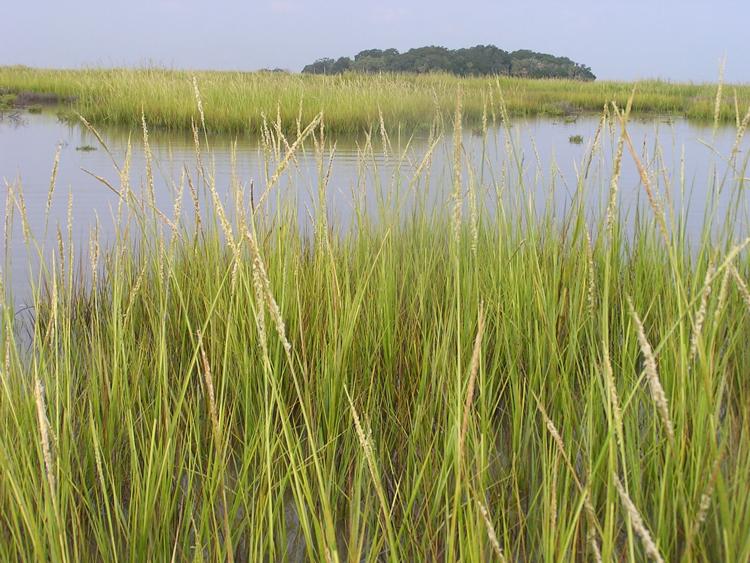
When guests step aboard a Blue Wave Adventures tour and glide out of the dock into the waterways of Murrells Inlet, the first thing most of them notice is the grass. It lines every bank, fills every creek edge, and stretches in every direction as far as the eye can see — tall, dense, intensely green in spring and summer, turning amber and gold in fall. It is, in many ways, the defining visual feature of the South Carolina salt marsh.
That grass has a name: Spartina alterniflora, commonly called smooth cordgrass or Atlantic cordgrass. And despite its humble, unremarkable appearance, it is arguably the single most ecologically important plant on the entire Atlantic seaboard.
Everything that lives in Murrells Inlet — every dolphin, every pelican, every blue crab, every mullet, every fiddler crab, every oyster, and yes, every shrimp on the plate at a Marshwalk restaurant — owes some part of its existence to spartina grass. This is not an exaggeration. It is a biological fact.
Here is why.
What Is Spartina Grass?
Spartina alterniflora is a perennial grass native to the Atlantic and Gulf coasts of North America. It grows in the intertidal zone — the band of habitat that is alternately flooded and exposed by the daily tidal cycle — and it is one of very few plants on Earth capable of surviving in that challenging environment. Most plants cannot tolerate saltwater immersion. Most cannot root in the anaerobic, sulfurous, waterlogged mud of a tidal flat. Spartina does both, and thrives.
In Murrells Inlet, spartina grows in two distinct forms: tall-form cordgrass, which can reach six feet or more in height and dominates the lower marsh along the creek banks and channel edges; and short-form cordgrass, which grows to roughly a foot in height and carpets the higher marsh areas that flood less frequently. Both forms are the same species, adapted to slightly different conditions within the same ecosystem.
The plant spreads through an extensive network of rhizomes — underground stems — that bind the marsh sediment together and expand the grass meadow outward over time. A single established clump of spartina can colonize acres of adjacent tidal flat over the course of decades, literally building new marsh habitat as it grows.
How Spartina Builds the Physical Marsh
Before spartina can do anything ecological, it first has to build the habitat in which everything else will live. And it does this in a remarkable way.
As the grass blades slow the flow of tidal water moving through the marsh, they cause suspended sediment particles to fall out of suspension and settle to the bottom. Over time — years, decades, centuries — this sediment accumulation raises the elevation of the marsh floor. New sediment layers deposit on top of old ones, the rhizome network binds them together, and the marsh literally grows upward and outward.
This process, called biogenic accretion, is how salt marshes expand and maintain their elevation in the face of tidal flooding. It is also how they respond to sea level rise — a healthy, spartina-dominated marsh can accrete sediment fast enough to keep pace with gradual sea level change, essentially building itself upward to maintain its position in the tidal frame.
Without spartina doing this work continuously, the tidal flats of Murrells Inlet would not be salt marsh at all. They would be bare mud — ecologically barren and structurally unstable. Spartina is the engineer that builds and maintains the physical structure of the entire system.
The Food Web Starts Here
Now comes the ecology — and this is where spartina’s importance becomes truly staggering.
Spartina grass is not grazed directly by many animals. The live blades are tough, silica-rich, and chemically defended against most herbivores. A few insects, some specialized snails, and the occasional goose will eat the living grass, but for the most part, spartina’s role in the food web does not begin with a hungry animal eating the green blade.
It begins with death.
When spartina dies — when the blades senesce and fall into the water at the end of the growing season, when storms break the stems, when the natural turnover of the plant releases dead organic matter into the tidal creek — that dead material is colonized by bacteria and fungi. These microorganisms begin breaking the plant tissue down into increasingly fine particles, a process called decomposition. As the bacteria and fungi work, they enrich the particles with their own cellular material, producing what ecologists call detritus — a nutritious slurry of partially decomposed plant material and microbial biomass.
This detritus is, quite simply, the base of the entire salt marsh food chain.
Fiddler crabs eat it. Grass shrimp eat it. Menhaden filter it from the water. Mud snails graze it from the sediment surface. Juvenile fish of dozens of species forage on it in the shallow creeks. Those animals, in turn, feed the larger animals that feed the larger animals still — the blue crabs, the red drum, the spotted seatrout, and eventually the bottlenose dolphins that hunt them in the tidal creeks of Murrells Inlet.
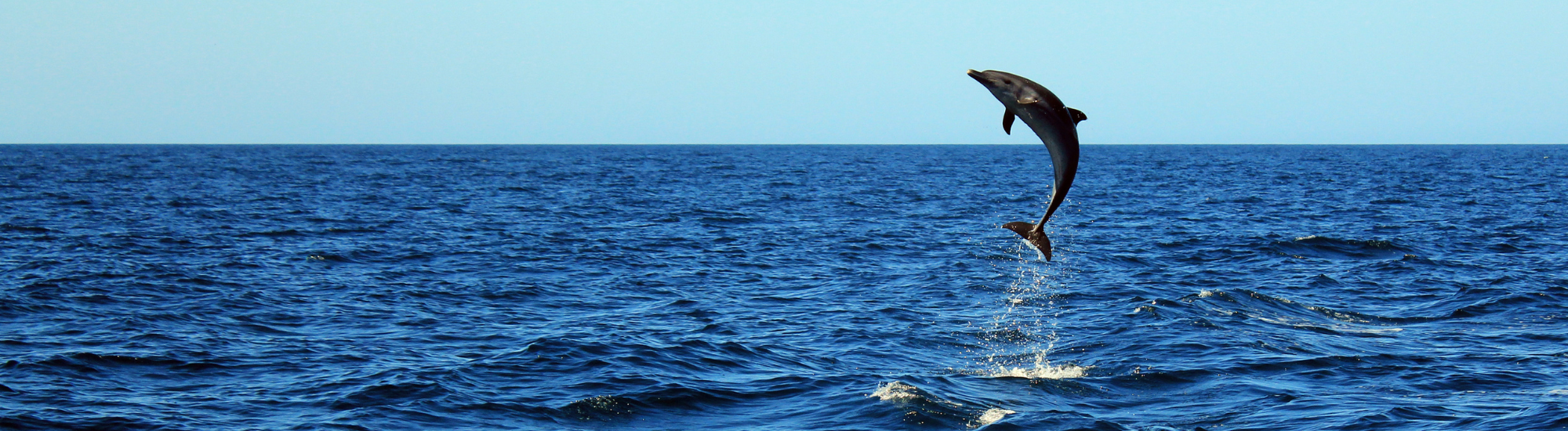
Every dolphin you see on a Blue Wave Adventures tour has, in a very real sense, been eating spartina grass. It has simply been transformed through four or five steps in the food chain before it reached them.
Nursery for the Ocean
The dense stands of spartina along the creek banks of Murrells Inlet serve another critical function: they are the nursery for a staggering proportion of the seafood that will eventually feed both wildlife and humans along the entire Atlantic coast.
The structural complexity of the spartina meadow — the tangle of stems, the labyrinth of root channels, the pockets of calm water sheltered from predators — makes it ideal habitat for juvenile fish and invertebrates. Almost every commercially important fish species in the South Atlantic Bight uses spartina-dominated salt marsh as a nursery habitat at some point in its early life cycle.
Juvenile red drum. Juvenile speckled trout. Juvenile flounder. Young blue crabs in their earliest instars. Juvenile white shrimp. Juvenile brown shrimp. All of these animals spend critical early months of their lives in the shelter of the spartina marsh, feeding on the detritus and small invertebrates that the system produces in abundance, and hiding from predators in the architecture of the grass.
When they grow large enough, they leave the marsh and move into open coastal waters — where they are caught by fishermen, eaten by larger fish, and pursued by the dolphins of the Grand Strand. The seafood economy of the entire South Carolina coast begins in the spartina marsh.
The Murrells Inlet commercial and recreational fishing industries — which together contribute hundreds of millions of dollars annually to the local economy — are, at their foundation, subsidized by Spartina alterniflora.
The Lungs and the Liver: Water Quality and Carbon Storage
Spartina grass does two additional things for the Murrells Inlet ecosystem that don’t get nearly enough attention: it cleans the water, and it stores enormous quantities of carbon.
Water Filtration
The dense root and rhizome network of spartina physically filters sediment from tidal water as it moves through the marsh, preventing it from reaching coastal waters where it would reduce clarity and smother seagrass beds and oyster reefs. The plants also absorb excess nutrients — particularly nitrogen and phosphorus from stormwater runoff — that would otherwise cause algal blooms and hypoxia (oxygen depletion) in the estuary.
Murrells Inlet’s water quality, which supports both its extraordinary wildlife and its economically vital shellfish beds, is substantially maintained by the nutrient-scrubbing function of the spartina meadow. The grass is, in effect, a living water treatment plant operating continuously on tidal energy alone.
Carbon Sequestration: Blue Carbon
Salt marshes are among the most powerful carbon sinks on Earth. The combination of high productivity (spartina grows fast and produces large quantities of biomass) and low decomposition rates in the anaerobic marsh sediment means that carbon fixed by the grass is buried in the sediment rather than released back into the atmosphere.
This buried carbon — called blue carbon — accumulates in the marsh sediment over centuries and millennia. Scientists have found spartina-derived carbon in salt marsh sediment cores dating back thousands of years. Per unit area, salt marshes sequester carbon at rates that rival or exceed tropical rainforests.
The spartina marshes of the South Carolina coast — including the extensive meadows of Murrells Inlet — represent a carbon store of genuine significance in the context of climate change. Protecting and restoring these marshes is increasingly recognized as one of the most cost-effective natural climate solutions available.
What Threatens Spartina in Murrells Inlet?
For all its toughness and ecological dominance, spartina and the marshes it builds are not invulnerable.
Sea level rise is the most significant long-term threat. Marshes can accrete sediment and grow upward in response to gradual sea level change, but if sea level rises faster than the marsh can build, the grass drowns and the habitat is lost. Reduced sediment input from developed watersheds — where stormwater is managed to prevent erosion — can limit the marsh’s ability to keep pace.
Coastal development directly removes marsh habitat through dredging, filling, and hardening of shorelines. Every bulkhead or riprap revetment installed along a marsh creek edge replaces living marsh with hard structure, eliminating the habitat value and the ecological services the grass provided.
Nutrient pollution from lawn fertilizers, agricultural runoff, and septic systems can actually cause marsh die-off in some situations by altering the competitive balance in the soil microbial community and weakening the grass’s root structure.
Invasive species — particularly Phragmites australis, the common reed — can outcompete spartina in disturbed or brackish areas, replacing it with a monoculture that provides far fewer ecological services.
Spartina and Your Tour
The next time you’re aboard a Blue Wave Adventures tour and you’re gliding through a tidal creek with six-foot walls of green grass on either side, consider what you’re actually seeing: a living machine that has been building, feeding, filtering, and storing carbon in this estuary for thousands of years. The fiddler crabs darting into their burrows in the mud bank are eating it. The mullet flashing silver in the bow wake are the products of it. The dolphin that just surfaced 20 feet off the starboard bow has been sustained by it through every link in the food chain that connects a grass blade to an apex predator.
Spartina alterniflora is not background scenery. It is the story.
Frequently Asked Questions About Spartina Grass and the Murrells Inlet Marsh
Why does the spartina grass turn brown and gold in the fall? Like many grasses, spartina undergoes seasonal senescence — the living green tissue dies back as temperatures drop and day length shortens. The dead standing stems remain through winter, providing important structure and habitat before new growth emerges from the rhizomes in spring. The golden color of the fall marsh is one of the most beautiful sights in the South Carolina Lowcountry.
Is the spartina marsh accessible on foot? Not safely. The sediment beneath the spartina grass is extremely soft, deep, and unstable — designed to hold the weight of a blade of grass, not a person. What looks like solid ground is often several feet of dense, waterlogged mud. The best — and safest — way to experience the spartina marsh is from the water, aboard a guided tour.
Is spartina grass the same as the reeds I see in freshwater wetlands? No. The tall reeds common in freshwater wetlands are typically Phragmites australis, a species that is actually considered invasive in many parts of North America. Spartina is a very different plant — shorter, finer-leaved, and adapted to saltwater conditions that Phragmites cannot survive.
Can I help protect the salt marsh? Absolutely. Using reef-safe, phosphate-free personal care products, reducing lawn fertilizer use, supporting local conservation organizations working in coastal South Carolina, and choosing ecotourism operators like Blue Wave Adventures who prioritize environmental stewardship are all meaningful contributions.
Come See the Marsh in Its Full Spring Glory
May is one of the most spectacular months to see the spartina marsh of Murrells Inlet. New growth is pushing up through the tidal mud, the creek banks are vivid green, and the entire system is coming alive after winter in a visible, tangible way. It is the best time of year to understand, viscerally, why this place is so important.
Questions about what you’ll see?
Blue Wave Adventures operates dolphin tours and nature cruises out of Murrells Inlet, SC, exploring the tidal creeks, salt marshes, and coastal waters of the Grand Strand. We are committed to educating every guest about the extraordinary ecological significance of this place — and to protecting it for the generations of dolphins, birds, and people who will call it home after us.
Sorry, the comment form is closed at this time.